
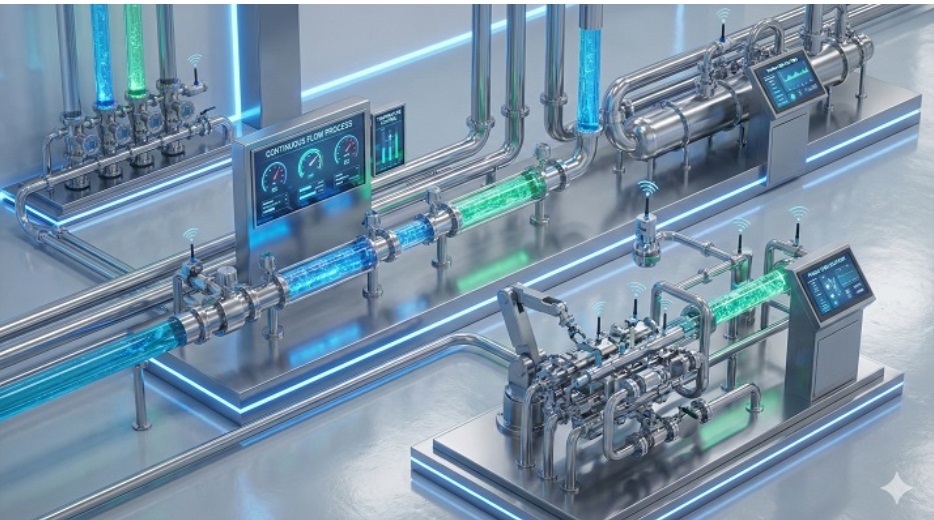
In many chemical and pharma plants, engineers struggle with inconsistent product quality, poor heat control, and unpredictable reaction behavior. These challenges reduce efficiency, profitability, and safety—especially when working with sensitive or high-value reactions. This is where plug flow reactors come in.
For plants looking to improve conversion, stabilize reactions, and switch to continuous manufacturing, understanding the top industrial applications of plug flow reactors in chemical and pharma plants becomes essential. A well-designed PFR can deliver higher yields, lower energy use, and far more predictable results than traditional batch systems.
Across industries, continuous processing is replacing batch operations. Manufacturers want faster reactions, better heat transfer, and systems that run reliably with minimal intervention. A plug flow reactor (PFR) supports all these goals.
It offers stable residence time, efficient mass transfer, and controlled temperature profiles, making it ideal for modern plants aiming to increase productivity and reduce operational risk. By delivering consistent conversion and repeatable results, PFRs improve efficiency, safety, and product quality.
A plug flow reactor (PFR) is a tubular continuous reactor where reactants move through the pipe in a uniform flow pattern. This design keeps back-mixing to a minimum and allows reactions to progress in a predictable manner. A PFR is also called a tubular reactor or continuous flow reactor.
Among the four main industrial reactor types—PFR, CSTR, batch, and semi-batch—the PFR is known for delivering higher conversion for continuous operations. For engineers asking “What type of reactor is a PFR?”, the answer is simple: a PFR is a continuous-flow tubular reactor ideal for steady, high-throughput processes.

A PFR operates based on three core principles: unidirectional flow, minimal back-mixing, and progressive reaction along the length of the reactor. As reactants enter the tube, they travel forward in a “plug-like” pattern. The concentration changes along the reactor length, which helps maintain high reaction rates at the inlet. This steady movement creates a predictable residence time, ensuring reliable conversion. This answers the common question: “What is the principle of PFR reactor?”
Compared to a continuous stirred-tank reactor (CSTR), a plug flow reactor offers several advantages:
So, which is better, CSTR or PFR?
For continuous, fast, or heat-sensitive reactions, a PFR usually performs better due to its consistent flow pattern and efficient mass transfer.
Chemical plants widely use PFRs for oxidation, nitration, alkylation, polymerization, and gas-phase catalytic processes. These reactions need stable flow, predictable heat control, and rapid conversion—areas where PFRs excel. When engineers ask “What are the uses of PFR in industry?”, the chemical sector provides the strongest examples of high-value applications.
In pharmaceutical production, PFRs are used for intermediate synthesis, continuous reactions, and high-purity pathways. They reduce batch variability and support consistent quality. This makes PFRs ideal for modern API manufacturing lines transitioning to continuous systems.
Fine chemicals often require very controlled reaction conditions. PFRs offer stable flow, predictable heat profiles, and reliable yields—perfect for high-value intermediates and specialty chemicals.
In fertilizer production, PFRs support reactions needing steady conversion and intensive heat management. Their ability to handle continuous processing makes them suitable for large-scale agrochemical plants.
Polypropylene, polyethylene, and related polymerization processes require precisely controlled temperature and flow. PFRs deliver the stability and consistency necessary for large-scale polymer production.
In petrochemical refining, PFRs are used for high-temperature reactions and continuous catalytic processes. Their strong heat transfer capabilities make them ideal for demanding refinery environments.
Real-world uses of PFRs include fine chemical plants, petrochemical refineries, polymer production units, and pharmaceutical intermediate facilities. These industries rely on PFRs because they offer predictable reaction pathways, better heat control, and consistent conversion—critical for long production cycles and high-value outputs.
PFRs maintain a stable flow pattern, helping sensitive reactions achieve better selectivity and fewer unwanted by-products.
Catalyst activity remains strong along the reactor length, improving conversion and reducing catalyst waste.
Fast or instantaneous reactions perform exceptionally well in PFRs because reactants quickly reach required conditions.
The concentration and temperature profiles remain consistent, making scale-up and optimization easier for engineers.
Continuous operation reduces stoppages, cleaning cycles, and manpower requirements compared to batch reactors.
Minimal back-mixing prevents dilution of reactants, ensuring stronger reaction driving force and higher conversion.
PFRs can handle high-temperature and high-pressure environments common in petrochemical and polymer processes.
For the same conversion, a PFR is significantly smaller than a CSTR, helping plants save installation space.
PFRs integrate easily with continuous feeding, monitoring, and discharge systems, improving process flow and productivity.
Stable flow and heat behavior ensure uniform product quality across long production cycles.
However, challenges exist. PFRs may face hot-spot formation in highly exothermic reactions, and temperature control can be difficult without advanced cooling systems. These are the common plug flow reactor disadvantages engineers must consider when choosing a reactor for continuous operations.
As industries move toward continuous manufacturing, automation, and digital monitoring, PFRs support these goals with ease. They align well with Industry 4.0, offer efficient energy use, and integrate smoothly with advanced control systems.
When engineers ask “What is the future of plug flow reactor technology?”, the answer is clear: PFRs are becoming central to modern, high-efficiency manufacturing environments.

TOPSE brings decades of engineering excellence to every plug flow reactor. Our systems are designed with precision engineering, advanced heat integration, and industry-grade material selection.
With robust automation, safety validation, and customized solutions for chemical and pharma plants, TOPSE ensures reliable operation, high performance, and long service life.
Our support covers design, installation, commissioning, and long-term service—making us a trusted partner for continuous processing equipment.
Plug flow reactors offer unmatched advantages across chemical, pharmaceutical, and polymer industries. By supporting continuous processing, improving conversion, and reducing operational risk, PFRs are becoming a preferred choice over traditional batch reactors. As manufacturing evolves, the role of PFRs will only grow stronger.
PFRs are used for continuous chemical and pharmaceutical reactions that require stable flow, controlled temperature, and high conversion.
Industries use PFRs for oxidation, polymerization, catalytic processes, and continuous API synthesis.
The four main industrial reactors are plug flow reactors, CSTRs, batch reactors, and semi-batch reactors.
A plug flow reactor is also known as a tubular reactor or continuous flow reactor.
A PFR operates on unidirectional flow, minimal back-mixing, and predictable residence time, allowing reactions to progress along the reactor length.