
Imagine staring at your plug flow reactor data, heart sinking as conversion rates plummet, reactions turn unstable, and hotspots threaten to shut down production. You're not alone—chemical and pharma engineers across India face these nightmares daily in high-throughput plants.
Residence time in plug flow reactor is the unsung hero that fixes poor yields, overheating, and inconsistent output, ensuring every reactant spends just the right time inside for peak performance. At TOPSE Process Solutions in Pune, we engineer PFRs that master this critical factor.
Residence time in a plug flow reactor is the average duration reactants stay inside before exiting as products. Think of it as the "dwell time" for your chemicals—too short, and reactions don't finish; too long, and you waste energy. This directly ties to conversion (how much reactant turns to product), selectivity (right products only), and full reaction completion, making it vital for efficient pharma and chemical ops.
Plug flow reactor working relies on unidirectional flow with almost no back-mixing, like cars in a single-lane tunnel moving forward only. Every fluid "plug" travels the reactor length with nearly identical residence time, creating an ideal plug profile where concentration drops steadily along the path. This uniform exposure boosts reaction control and output quality.

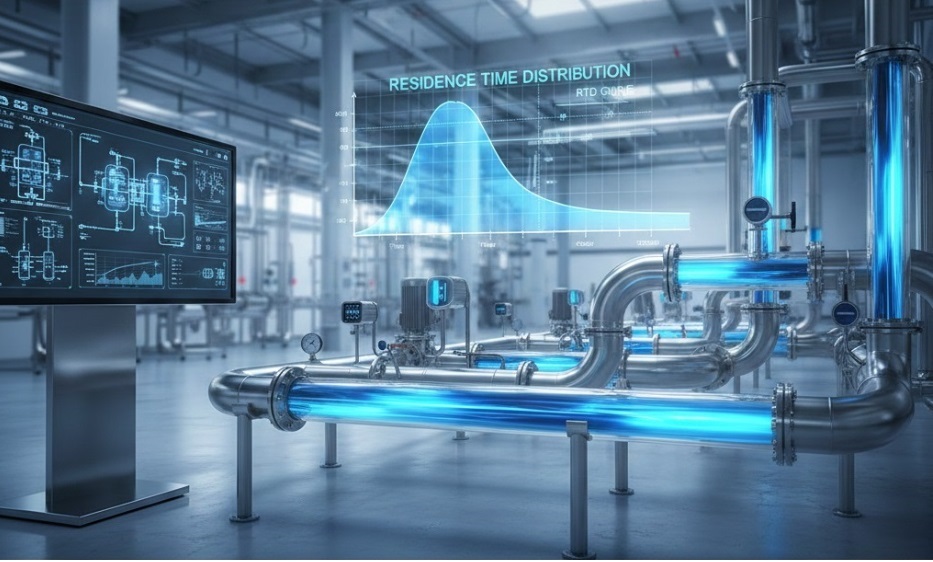
Residence time distribution in plug flow reactor, or RTD, tracks how long different fluid elements linger inside—ideal PFRs show a sharp spike at one time, but real ones spread slightly due to imperfections. Poor RTD slashes conversion by letting some plugs rush through unfinished while others overstay. In catalytic cracking, polymerization, or pharma synthesis, tight RTD means reliable yields and fewer rejects.
The basic formula is:
τ = V / Q
Where:
This simple equation helps engineers understand how to calculate residence time in plug flow reactor systems.
Real-world residence time is affected by:
Regular monitoring ensures more accurate predictions and stable reactor output.
The residence time equation for a PFR connects reaction rate, flow velocity, and reactor length.
At a basic level:
τ = L / u
Where:
This residence time equation plug flow reactor model helps determine how long reactants remain in the system and what conversion you can expect.
Conceptually, higher residence time → higher conversion, until equilibrium or catalyst limits are reached.
Flow velocity swings from pump inconsistencies cut residence time, while temperature hikes speed up flow and pressure tweaks density. Catalyst deactivation lengthens effective time unevenly, and poor mixing creates dead zones. Reactor specs like length, diameter, and internals (baffles, coils) fine-tune it—smart design keeps everything steady.
Residence time plays a major role in:
These industries offer strong plug flow reactor example cases where residence time directly affects performance.
Optimal residence time lifts product quality by nailing purity, spikes conversion efficiency, and sharpens selectivity for max yield. Unlike batch reactors' variable times, continuous PFRs deliver steady output—advantages like smaller size beat CSTRs, but watch disadvantages like hotspot risks in exotherms.
Industrial reactors face several residence-time-related challenges:
TOPSE Plug Flow Reactor address these issues using advanced flow distribution, precision design, and engineered internals.

TOPSE crafts precision geometry for ideal plug flow, pairs it with advanced heat systems slashing energy use, and guarantees stable distribution via custom manifolds. Automation and real-time sensors track every second, tailored for chemical oxidation or pharma needs. Pune-built reliability means no guesswork—just results.
Mastering residence time unlocks top conversion, yield, and safety in PFRs, powering chemical and pharma plants without downtime. Pick TOPSE for proven designs that nail it every time—your path to efficient, cost-saving production starts here.
It is the average time reactants spend inside a PFR from inlet to outlet.
Use the formula τ = V / Q, where V is reactor volume and Q is flow rate.
Flow velocity, temperature, viscosity, pressure, reactor design, and fouling.
RTD shows how long different particles stay in the reactor, helping assess performance.
A PFR offers predictable residence time, while a CSTR has broad mixing and wide time distribution.
It controls conversion, selectivity, yield, and thermal behavior, impacting overall efficiency.