
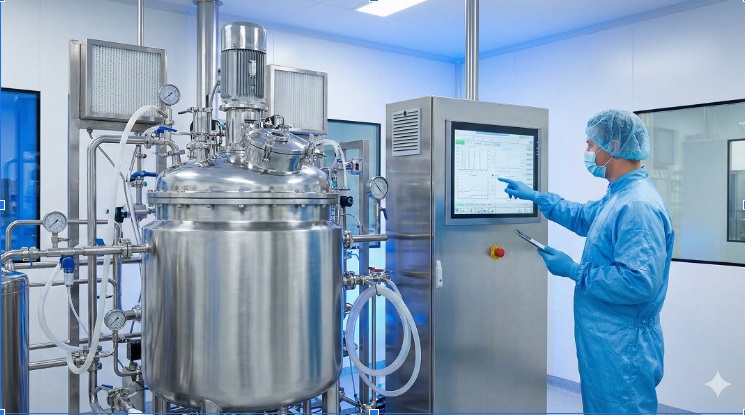
Imagine arriving at your fermentation facility early in the morning. You open the batch report, expecting stable numbers — but instead, the room drops silent. The pH curve looks wrong. Dissolved oxygen plummeted overnight. A high-value batch has failed. Again.
Your QA team is already waiting. Production timelines are slipping. Regulatory audits are nearing. And you can feel the pressure rising in your chest because you know what this means:
Contamination.
The single biggest threat to your fermentation process — and to your plant’s reputation.
For pharmaceutical and biotech manufacturers, contamination doesn’t just waste time or raw materials. It threatens patient safety, regulatory compliance, and the credibility of the entire operation. That’s why so many leaders start searching how to prevent contamination in a fermenter when one batch failure feels like ten steps backwards.
Let’s break down exactly how contamination happens — and how to stop it before it starts.
Contamination occurs when unwanted microorganisms or foreign particles enter your fermenter. These could be bacteria, fungi, wild yeast, dust particles, traces of unsterile media, or even microbes carried in from human handling.
In high-stakes pharma and biotech settings, even a single contaminant can compromise:
This is why contamination prevention is not optional — it’s foundational.
Think of your fermenter like a perfectly controlled physics experiment. Everything inside is a closed system designed to behave predictably. Now imagine dropping one foreign particle into that system — it changes the entire reaction.
That’s exactly what contamination does:
A tiny microbial “intruder” disrupts pH, DO, nutrient balance, cell metabolism, and ultimately product yield.
Before a batch collapses completely, it usually sends signals. Watch for:
Early detection can save lakhs — or even crores — of production value.
Your fermenter’s design is your first line of defense. Choose systems that comply with ASME-BPE standards, offering:
These design features drastically reduce microbial harborage and strengthen sterilization performance.
TOPSE’s fermenters are engineered around these principles, making them naturally resistant to contamination risks.
A poorly sterilized system is the fastest route to a contaminated batch.
What you need is:
Automation reduces manual dependency — and fewer manual steps mean fewer contamination opportunities.
Air is one of the most underestimated contamination sources.
Focus on:
A single compromised sterile filter can introduce airborne organisms directly into your fermenter — and the batch is gone before you even see it happening.
Media is the “food” for your production strain — and contaminants love it too.
Best practices include:
When media is handled aseptically from the start, contamination risk decreases dramatically.
This answers common PAA questions like “How can you control contamination in fermentation?”
Real-time online monitoring helps maintain sterility by automating control over:
Advanced HMI/SCADA systems — like the ones in TOPSE’s fermenters — minimize human error and ensure 21 CFR Part 11 compliant data logging for regulatory confidence.
Cross-contamination is often invisible until it destroys an entire production cycle.
Strengthen your barriers by:
Cross-contamination is preventable — but only when the facility layout and behavior patterns support it.
Contamination isn’t just “an operational issue.” It has measurable, costly consequences:
In pharma and biotech manufacturing, contamination is not just a batch problem — it’s a business problem.
Contamination can enter the system through multiple pathways:
Incomplete CIP/SIP cycles, cold spots, or ineffective steam distribution.
Non-sterile components or improper transfer methods.
Filter failures, wet-gas lines, or poor integrity testing.
Dead legs, rough welds, poor drainability, and microbial traps.
Sample collection, additions, and interactions without aseptic technique.
Leaks, worn gaskets, pressure fluctuations.
Understanding the root cause is the first step toward building a contamination-free fermentation environment.

TOPSE’s fermenter systems are engineered for pharma and biotech environments where sterility is non-negotiable. With hygienic ASME-BPE & ASTM-compliant design, automated CIP/SIP/E-SIP cycles, and advanced HMI/SCADA systems with 21 CFR Part 11 compliant data acquisition, TOPSE supports contamination-free operations from upstream to downstream.
A strong QA/QC foundation reinforces your contamination control strategy.
This includes:
When QA and production work together, contamination risks fall sharply.
People are often the most unpredictable part of any process. Clear SOPs can eliminate that uncertainty.
Focus on:
Discipline in operations is just as important as advanced equipment.
Your fermenter behaves like an isolated physics experiment. Nothing unwanted should enter the system.
Variables such as pH, temperature, DO, and airflow are controlled by feedback loops — just like a physics system stabilizes itself through equilibrium.
Contamination disrupts this balance, pushing the system into unpredictable failure.
Fermentation contamination is more than an inconvenience — it’s one of the biggest threats to quality, compliance, and profitability in pharmaceutical and biotech manufacturing. By investing in hygienic fermenter design, validated sterilization, sterile inputs, advanced automation, and disciplined SOPs, plant managers can safeguard every batch from contamination.
Choosing systems like TOPSE’s turnkey, automated, and compliant fermenters gives you the control and confidence you need to maintain sterility and deliver consistent results.
Are you ready to upgrade your fermentation setup to eliminate contamination risks once and for all?